TL;DR
This executive guide settles the debate between old-school tactics and the new algorithmic reality. We answer the critical question of why a growth marketing strategy is the only viable path in 2026. The article dissects the failure of traditional “spray and pray” methods in an era of AI agents and zero-click search. We explore the pillars of a modern marketing approach, including full-funnel optimization, rapid experimentation, and community-led growth. Furthermore, we provide a roadmap for pivoting from vanity metrics to actionable revenue drivers. By adopting these protocols, C-level executives can lower CAC and increase LTV in a volatile market.
Introduction
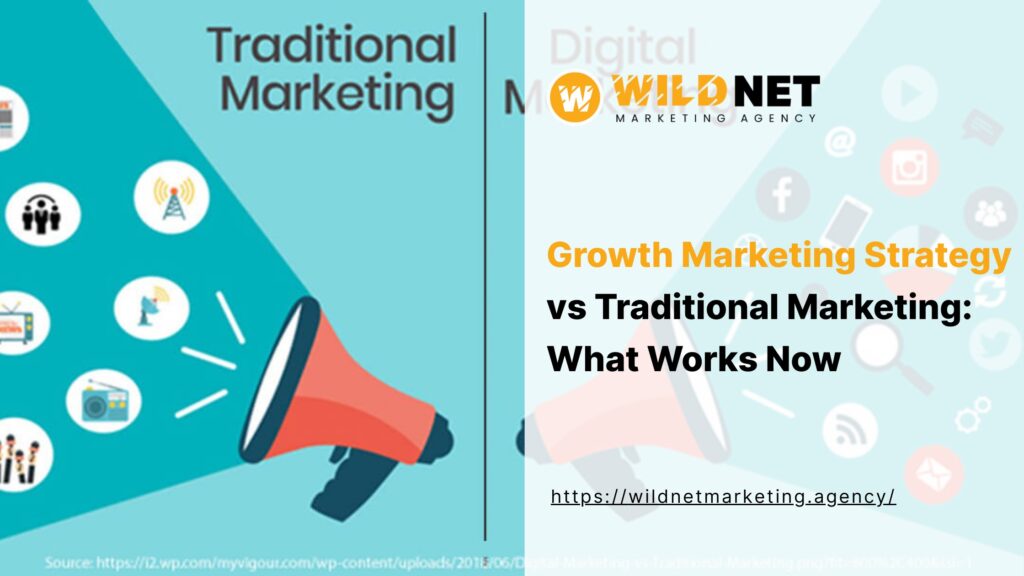
The era of buying attention is over; the era of earning it has begun. In 2026, the distinction between growth marketing vs traditional marketing is no longer a stylistic choice—it is a survival mechanism. Traditional marketing, with its reliance on broad reach and unmeasurable brand awareness, is hemorrhaging budget. In contrast, a robust growth marketing strategy thrives on precision, data, and rapid iteration.
For marketing leaders, the shift to a modern marketing approach is non-negotiable. Consumers today utilize AI agents to filter out noise, making traditional interruption tactics obsolete. If your playbook still relies on static quarterly campaigns, you are fighting a losing war. This guide breaks down exactly why this data-driven framework works now and how to implement it to secure your market share.
The Collapse of Traditional Marketing
Traditional marketing was built for a world of scarcity—limited TV channels, limited shelf space, and limited choice. It focuses heavily on “Top of Funnel” awareness. You buy a billboard or a banner ad, hope for impressions, and pray for sales.
In 2026, this model fails because attention is fragmented. A growth marketing strategy recognizes that “awareness” without “retention” is a waste of capital. Traditional methods often lack the attribution loops necessary to prove ROI. When you compare the two, the latter is often a black hole of spending, whereas a growth-focused plan is a profit-generating engine.
Defining the Methodology
This is not just “marketing with data.” It is a holistic, full-funnel approach that integrates product, engineering, and marketing. Unlike traditional methods that stop at the sale, a growth marketing strategy obsesses over the entire lifecycle: Acquisition, Activation, Retention, Revenue, and Referral (AARRR).
In 2026, this framework utilizes AI to run thousands of experiments simultaneously. It doesn’t guess what works; it tests. This scientific rigor is the hallmark of a modern marketing approach. By constantly tweaking the user journey, you compound small wins into massive revenue growth.
Key Differences: Why Growth Wins
The battle of growth marketing vs traditional marketing comes down to agility.
- Focus: Traditional marketing focuses on the company. A growth marketing strategy focuses on the user.
- Speed: Traditional marketing plans in quarters. Growth teams execute in weekly sprints.
- Metrics: Traditional marketing chases vanity metrics like “Reach.” A growth marketing strategy chases value metrics like “Customer Lifetime Value” (LTV).
Adopting these tactics means accepting that you don’t have all the answers—the data does. This humility allows a growth marketing strategy to pivot instantly when market conditions change, whereas traditional campaigns are often too heavy to move.
What Works Now: The 2026 Playbook
So, what does a high-performance growth marketing strategy look like today?
1. AI-Driven Personalization
A modern marketing approach uses AI not just to write copy, but to predict intent. Your growth marketing strategy should leverage “AI Agents” that interact with customers 1:1, offering hyper-personalized recommendations.
2. Community as a Moat
In a world of AI-generated content, human connection is premium. A successful plan builds “owned communities” (Discord, Circle) where users talk to each other. This reduces reliance on paid ads.
3. Product-Led Growth (PLG)
The ultimate growth marketing strategy is a product that sells itself. By offering “freemium” tiers or interactive demos, you lower the barrier to entry. This is vastly superior to traditional “Request a Demo” forms.
4. Video-First Content
Text is being summarized by AI; video is being watched by humans. Your infrastructure must prioritize short-form video to capture attention in the “infinite scroll” economy.
How to Pivot to a Modern Marketing Approach
Transitioning from traditional to growth requires a cultural shift. You must tear down the silos between sales, marketing, and product.
Start by defining your “North Star Metric”—the single number that best reflects value delivered to the customer. Then, build your growth marketing strategy around moving that number. Stop celebrating “views” and start celebrating “active users.” Implementing a modern marketing approach also means embracing failure. In this framework, a failed experiment is just data that gets you closer to the truth.
Retention is the New Acquisition
The biggest flaw in traditional marketing is the “leaky bucket.” You pay to acquire a user, they buy once, and they leave. A growth marketing strategy plugs the leak.
In 2026, acquisition costs are at all-time highs. Therefore, the most profitable path is often retention marketing. By using email automation, loyalty programs, and in-app nudges, you increase LTV. This focus on the bottom of the funnel is what separates a mature modern marketing approach from a novice one.

Conclusion
The verdict on growth marketing vs traditional marketing is clear: adapt or die. A growth marketing strategy offers the resilience and efficiency required to navigate the 2026 landscape. By moving away from vanity metrics and embracing a full-funnel modern marketing approach, you build a business that is future-proof. It is not about working harder; it is about experimenting faster. At Wildnet Marketing Agency, we don’t just run campaigns; we engineer success. Are you ready to leave traditional methods behind?
FAQs
Q.1 What is the main difference between growth marketing vs traditional marketing?
Ans. The main difference is the funnel. Traditional marketing focuses only on acquisition (top of funnel), while a growth marketing strategy focuses on the entire customer lifecycle, including retention and referral.
Q.2 Is this approach expensive?
Ans. Not necessarily. Because it relies on data and testing, these tactics often reduce waste by cutting budget from channels that don’t perform, unlike traditional “spray and pray” methods.
Q.3 Can small businesses use a modern marketing approach?
Ans. Absolutely. Scalability is key. Small businesses can use the same experimentation mindset as large tech companies to find their unique path to revenue.
Q.4 How long does a growth marketing strategy take to work?
Ans. It is iterative. While you might see quick wins from A/B testing, the compounding effects typically mature over 6-12 months.
Q.5 Does this replace SEO?
Ans. No, it includes SEO. SEO is a channel; the growth marketing strategy is the framework. Modern teams use SEO to drive long-term, compounding traffic.
Q.6 Why is retention part of the strategy?
Ans. Because keeping a customer is cheaper than finding a new one. This framework prioritizes retention to maximize LTV, which funds further acquisition.
Q.7 What tools do I need?
Ans. You need analytics (GA4), CRM (HubSpot/Salesforce), and testing tools (VWO/Optimizely). These comprise the tech stack for a functional growth marketing strategy.