Key Takeaways
- Full funnel marketing is a holistic strategy that engages customers at every stage from awareness to advocacy, ensuring continuity and relevance.
- Understanding marketing funnel stages, awareness, consideration, conversion, and retention, is essential to delivering the right message at the right time.
- A strong marketing strategy framework blends data, technology, personalization, and cross-team alignment to guide prospects effectively through the funnel.
- Continuous conversion funnel optimization is critical: test, measure, and adjust tactics to improve performance at every stage.
Introduction
The current online environment requires brands to develop their online presence because traffic generation does not deliver sufficient results. Brands must understand how to draw in potential customers, create their interest, and turn them into buyers while keeping their customers active until after the transaction ends. Full funnel marketing provides businesses with an all-encompassing method that helps them manage their sales process from initial contact until final conversion while optimizing customer interactions throughout the entire process.
The guide will explain full funnel marketing, which includes its importance and its distinction from standard methods, and its practical implementation to create a full-funnel marketing system that achieves both predictable outcomes and ongoing expansion.
What Is Full Funnel Marketing?
The practice of full funnel marketing establishes a system that connects with potential customers at every stage of their purchasing process through its method of delivering suitable messages to specific customer groups at appropriate moments. The full funnel marketing approach establishes marketing continuity while enabling personalized experiences, which different teams can execute through their various communication channels.
This method creates a common narrative that unites marketing, sales, and customer success teams to work toward shared objectives. The system considers the entire revenue process as one continuous operation instead of separate marketing initiatives.
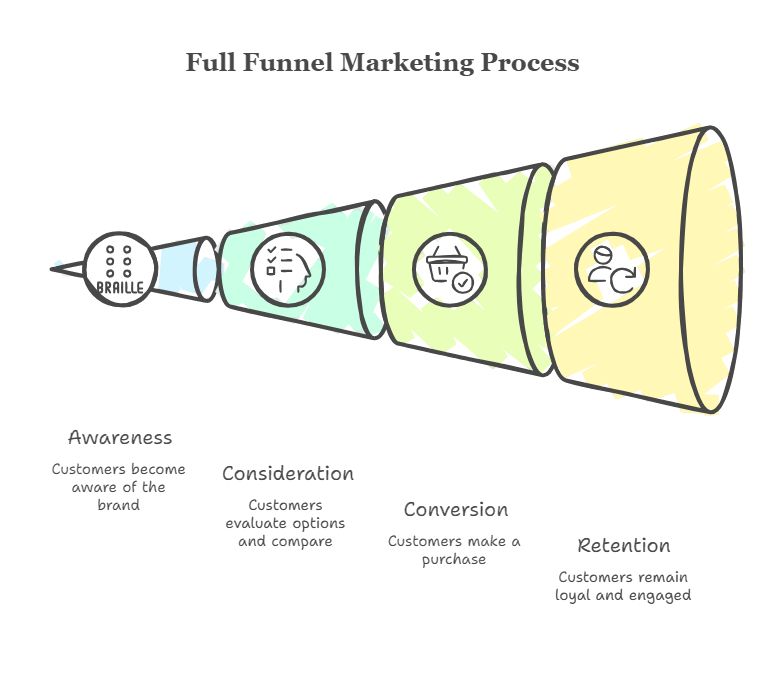
The Marketing Funnel Stages: A Complete Framework
A complete understanding of marketing funnel stages serves as the basic requirement for executing full funnel marketing. Most modern frameworks approximately divide the customer journey into three essential steps, although various models present different approaches.
1. Awareness (Top of Funnel / TOFU)
A potential customer discovers your brand for the first time during this moment. The focus here is visibility and education, introducing your company to audiences who may not know they have a need yet.
TOFU goals include:
- The goal is to increase brand visibility
- The goal is to connect with new audiences who find our content highly relevant
- The introduction of solutions will address multiple significant customer challenges
The full funnel marketing approach uses content marketing, social media, SEO and display ads and influencer partnerships, and PR as its strategic elements.
2. Consideration (Middle of Funnel / MOFU)
Prospects reach this stage after they understand their problem and assess their available solutions. The goal is to nurture interest, build trust, and differentiate your value.
MOFU goals include:
- Educating prospects on your solution
- Showing real value versus alternatives
- Capturing engagement signals (email sign-ups, demo requests)
The organization uses email nurturing with retargeting ads and webinars, together with case studies, as its main tactics.
3. Conversion (Bottom of Funnel / BOFU)
Here, prospects are ready to decide. The team works to improve conversion rates by eliminating customer objections while demonstrating product value and establishing simple purchasing processes.
The BOFU objectives consist of:
- Making the sale
- Driving sign-ups or purchases
- Reducing friction for first-time buyers
The organization uses personalized offers together with free trials, product comparisons, and targeted calls-to-action as its main tactics.
4. Retention & Advocacy (Beyond Purchase)
The current sales process goes beyond achieving customer conversion. The business needs to maintain existing customers who have reached their three vital stages, which include retention, loyalty, and customer advocacy. Customers who remain loyal to a brand will continue to buy its products while also promoting the brand to others.
Goals for customer retention include:
- Successful onboarding
- Successful upselling and cross-selling
- Creating a system that benefits customers who refer others and return to the business
The organization uses multiple tactics, which include loyalty rewards and post-purchase content, and supports communities and feedback loops.
Why Full Funnel Marketing Strategy is Crucial in 2026
Traditional marketing methods focused on achieving immediate results through lead generation and direct sales. But buyers today don’t follow a neat, linear path; they move across devices, channels, and research touchpoints before converting.
A full-funnel marketing strategy is crucial because:
1. Customers expect consistency across channels: Buyers prefer continuous relevant experiences, which include personalized content at all their contact points.
2. Buying journeys are nonlinear: Prospects skip back and forth between stages, meaning isolated, stage-by-stage campaigns miss opportunities.
3. Alignment improves efficiency: When marketing, sales, and customer success share data and performance goals, organizations convert more efficiently and reduce waste.
4. Better data fuels smarter decisions: Integrated funnel strategies help teams track customer behavior throughout the buying process, which allows them to make ongoing improvements.
The combined results of these activities will establish full funnel marketing as an essential business asset that delivers competitive benefits throughout 2026 and future years.
How a Full Funnel Marketing Strategy Works
A full funnel marketing strategy functions as an interconnected system rather than a collection of independent campaigns. It integrates people, processes, data, and technology to guide prospects seamlessly from first interaction to long-term loyalty. Instead of optimizing isolated touchpoints, the full funnel approach ensures every marketing program contributes to a unified customer journey.
The system operates according to these steps:
1. Unified Goals Across Teams
The full funnel marketing measures pipeline growth and conversion rates, customer retention, and customer lifetime value through shared business objectives. The shared measurement system between teams leads to increased collaboration while teams work on their own key performance indicators.
The advantages of the system include:
- The system unifies marketing and sales operations, which currently function as separate entities.
- The system allows organizations to share customer information with greater detail about their data assets.
- The system helps teams work together to enhance their performance through optimization processes.
2. Personalized Messaging by Stage
The complete marketing funnel system needs to deliver personalized content that matches the actual location of a prospect throughout their customer journey.
Examples:
- TOFU content provides answers to discovery questions
- MOFU nurtures established customer trust through educational content
- BOFU offers provide solutions to particular buying indicators
3. Integrated Channels for a Seamless Experience
Channels are not independent avenues; they work in concert to guide behavior.
Integrated channels might include:
- Search ads linked to related landing pages
- Retargeting ads triggered by specific actions
- Email workflows personalized by engagement
4. Data-Driven Optimization
Your analysis of the complete conversion funnel optimization process requires you to measure multiple vital metrics, which include user engagement at the start, lead assessment during the middle, and customer conversion and retention performance at the end. The implementation of conversion funnel optimization guarantees that your efforts generate actual benefits from every user interaction instead of solely attracting visitors.
Conversion Funnel Optimization: The Core of Performance
Conversion funnel optimization is the engine that determines whether a full funnel marketing strategy succeeds or fails. While traffic generation and engagement create momentum, optimization is what converts that momentum into measurable business outcomes. Without it, even the most well-designed funnels leak prospects, inflate acquisition costs, and underperform against revenue goals.
At its core, conversion funnel optimization is a continuous, data-driven process that improves how prospects move through each stage of the funnel by reducing friction, increasing relevance, and aligning marketing actions with real buyer behavior. The process include:
1. Engagement signals tracking: Marketers use engagement signals to track how potential customers interact with different marketing channels.
2. A/B testing process: The team conducts A/B tests to find better ways to communicate with customers through different messaging options and landing page designs and calls-to-action elements.
3. Customer behavior alignment: The business delivers offers and content which fulfill current customer requirements during their journey through different business stages.
4. Reducing friction: The business process focuses on reducing customer drop-off points by improving all aspects of customer interaction through form design, checkout process, and lead qualification methods.
Full funnel marketing needs to operate with both efficiency and relevant marketing content as its main focus. Your funnel loses potential customers and incurs additional expenses due to missing optimization.
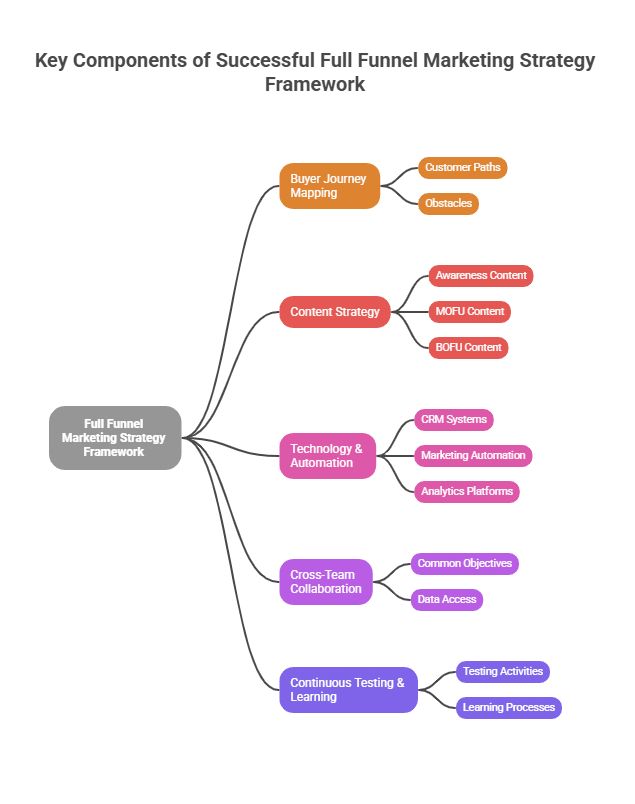
Key Components of Successful Full Funnel Marketing Strategy Framework
A marketing strategy framework is the structural foundation that enables full funnel marketing to function as a repeatable, scalable growth system. Without a clearly defined framework, funnel activities often become fragmented, reactive, and difficult to optimize. A strong framework ensures that every campaign, channel, and message contributes meaningfully to moving prospects through the funnel.
To create an effective marketing strategy framework that enables complete funnel marketing execution, marketers need to implement these essential components:
1. Buyer Journey Mapping
The actual paths that prospects follow must be understood because customers can either return to previous stages or skip steps. The mapping process identifies all major obstacles that require special attention.
2. Content Strategy Aligned to Funnel Stages
Create content designed to meet particular requirements because awareness content serves educational purposes, while MOFU content provides customer support, and BOFU content helps customers make choices.
3. Technology & Automation
The organization should implement CRM systems together with marketing automation tools and analytics platforms to establish a centralized data repository that enables automated personalized customer experiences at large scale.
4. Cross-Team Collaboration
Marketing and sales must work toward shared goals and operate from the same data set. Full funnel marketing aligns both teams around the entire buyer journey—from first touch to conversion and retention. When marketing and sales have complete access to funnel data, they can coordinate messaging, prioritize high-intent leads, and close deals faster without friction.
5. Continuous Testing & Learning
The organization should establish a system that includes ongoing testing activities and subsequent learning processes to identify successful strategies that need optimization before achieving capacity expansion.
Top Tactics for Each Marketing Funnel Stage
A successful full funnel marketing strategy depends on executing the right tactics at the right stage of the customer journey. Each phase of the marketing funnel represents a different mindset, level of intent, and information need. Applying the same tactics across all stages reduces effectiveness and weakens overall funnel performance. Below are proven, actionable tactics for each stage of the funnel, along with explanations of how and why they work.
Awareness (TOFU)
- SEO and organic content
- Educational blogs, guides, and FAQs
- High-reach paid social and display ads
- Influencer partnerships
Consideration (MOFU)
- Lead magnets (eBooks, courses)
- Retargeting campaigns
- Webinars and demos
- Email nurture sequences
Conversion (BOFU)
- Personalized offers
- Free trials or consultations
- Product comparisons
- Testimonials and case studies
Retention & Advocacy
- Loyalty programs
- Check-in emails and support content
- Referral incentives
Measuring Success: Metrics for Full Funnel Marketing
Measuring success in full funnel marketing requires more than tracking isolated performance indicators such as traffic or conversions. Because a full-funnel approach spans the entire customer journey, its measurement framework must evaluate how prospects move through all marketing funnel stages, from first exposure to long-term retention.
- The full funnel metrics system evaluates marketing performance through all stages of the customer journey.
- The following metrics measure customer awareness through their impressions and reach, and new visitor count.
- The consideration stage of customer assessment uses three metrics, which include engagement time, lead quality, and nurture response.
- The conversion stage uses two metrics, which measure conversion rate and cost per acquisition.
- The retention stage of customer assessment uses three metrics, which include repeat purchase rates, churn, and customer lifetime value.
Common Mistakes in Full Funnel Marketing
The execution of full funnel marketing remains difficult for all marketing organizations which have reached advanced development stages. The organization experiences funnel performance decline because of hidden gaps which exist in both their structural and strategic elements. The organization needs to identify its top marketing mistakes, which requires systematic solutions, because of their importance in developing a full-funnel marketing system that can grow with the company.
1. Siloed Teams Across the Funnel
The funnel system fails when marketing and sales and customer success departments work separately from each other.
Why this happens:
Different teams operate their business functions to achieve their individual performance targets because marketing needs leads and sales needs deals and customer success needs to maintain a customer base.
How it hurts the funnel:
- Leads pass through the system without their accompanying context and intent signals
- Sales conversations lack an essential connection to the previous marketing commitments.
- Customer success personnel need to understand the buyer expectations which sales teams established during the acquisition process.
How to fix it:
- Align all teams around shared funnel and revenue metrics
- Centralize customer data in a single CRM and analytics system
- Establish feedback loops between pre-sale and post-sale teams
2. One-Size-Fits-All Messaging Across Marketing Funnel Stages
The practice of using identical messages to approach all potential customers throughout their purchasing journey leads to one of the most frequent errors which results in significant financial losses.
Why this happens:
Teams often prioritize scale over relevance, reusing the same creatives, emails, or landing pages across multiple stages.
How it hurts the funnel:
- Sales-heavy messaging creates an overwhelming experience for users who reach the awareness stage.
- Educational content at the consideration stage fails to provide the sufficient learning materials that potential customers need.
- Urgency signals and reassurance messages do not reach buyers who are prepared to make their purchases.
How to fix it:
- Map content and messaging explicitly to each stage of the funnel
- Personalize communication based on behavior, not assumptions
- Design distinct TOFU, MOFU, and BOFU value propositions
3. Ignoring Post-Purchase Engagement and Retention
Many teams stop investing once they secure the first conversion, which is a costly mistake in modern funnel design. Full funnel marketing treats the post-purchase stage as just as important as acquisition by focusing on onboarding, engagement, and retention. When brands continue nurturing customers after the sale, they increase lifetime value, reduce churn, and turn one-time buyers into repeat customers.
How it hurts the funnel:
- The traditional sales funnel design treats the sale as the final stage, which results in permanent value loss for businesses.
- The funnel experience suffers because of two different problems that affect customer behavior:
- The first problem occurs because higher churn rates result in decreased customer lifetime value.
- The second problem occurs because businesses lose potential upsell and cross-sell sales opportunities.
- The third problem occurs because customers make fewer referrals to the business while their support for the brand decreases.
How to fix it:
- The solution requires you to expand your funnel system by adding onboarding processes, together with retention activities and loyalty programs.
- The company should use post-purchase data to create personalized customer interactions, which will enhance future engagement efforts.
- The complete marketing strategy should incorporate customer success activities as part of its entire funnel approach.
How it hurts the funnel:
- Higher churn rates reduce customer lifetime value
- Missed upsell and cross-sell opportunities
- Fewer referrals and weaker brand advocacy
How to fix it:
- Extend your funnel to include onboarding, retention, and loyalty
- Use post-purchase data to personalize future engagement
- Integrate customer success into your full-funnel marketing strategy
4. Incomplete Funnel Visibility and Poor Analytics
Optimization depends on having clear visibility across every stage of the funnel. Full funnel marketing requires accurate, connected data from first interaction to conversion and retention. When teams lack complete funnel analytics, they optimize in silos, misread performance, and miss the real drivers of growth.
Why does this happen:
Organizations track isolated metrics, traffic, leads, or conversions, without understanding how stages influence one another.
How it hurts the funnel:
- You cannot identify where prospects drop off
- The budget funds channels that do not produce successful results
- Conversion funnel optimization becomes reactive, not strategic
How to fix it:
- Track performance across every funnel stage, not just conversions
- Measure lead quality, engagement depth, and retention metrics
- Use insights to continuously refine your full-funnel marketing strategy
Bottom Line
Organizations require full funnel marketing as a strategic requirement because digital competition grows stronger and customer journeys become more complex. Organizations that depend on uncoordinated marketing campaigns and separate funnel marketing methods will experience decreased brand value, operational efficiency, and financial decline.
A complete marketing strategy uses full-funnel execution, which creates a unified revenue system that unites all marketing touchpoints across the complete customer journey from first contact to ongoing customer loyalty. The process ensures that potential customers receive tailored contact points, which lead to enhanced business performance while organizations maintain their common objectives through data-driven modifications of their sales processes.
Wildnet Marketing Agency builds and executes complete marketing solutions that help contemporary businesses through its experience with unified full-funnel marketing systems. Wildnet supports brands in their marketing efforts by providing complete solutions that include audience identification and content development, automation and analysis, and performance enhancement.
Wildnet enables organizations to achieve their goals through its expertise in deep funnel analysis, its capacity to use data for decision-making, and its ability to operate different marketing channels.
FAQ
Q.1. What is full funnel marketing?
Full funnel marketing is a holistic approach that engages customers across all stages of the buying journey from awareness to retention and advocacy using aligned messaging, channels, and data to drive consistent growth.
Q.2. What are the main marketing funnel stages?
The core marketing funnel stages include awareness, consideration, conversion, and retention. Each stage requires different messaging, content, and tactics to move prospects forward effectively.
Q.3. How is a full-funnel marketing strategy different from traditional marketing?
A full-funnel marketing strategy focuses on the entire customer lifecycle rather than isolated goals like lead generation or sales. It integrates teams, data, and channels to optimize long-term revenue, not just short-term results.
Q.4. Why is conversion funnel optimization important?
Conversion funnel optimization ensures that each funnel stage performs efficiently by reducing friction, improving relevance, and increasing the likelihood that prospects move toward conversion and retention.
Q.5. Can small or mid-sized businesses use full funnel marketing?
Yes. Full funnel marketing is scalable. With the right marketing strategy framework, even small teams can prioritize key funnel stages, automate processes, and optimize performance without large budgets.
Q.6. What tools support full funnel marketing execution?
Common tools include CRM platforms, marketing automation software, analytics dashboards, and personalization engines. These tools help track behavior across funnel stages and enable data-driven optimization.
Q.7. When should a company work with a full funnel marketing agency?
A company should consider an agency when it needs cross-channel expertise, advanced analytics, or faster execution. Agencies like Wildnet help design, implement, and optimize full-funnel marketing strategies for sustainable growth.