Key Takeaways
- A conversion funnel optimization helps guide users step by step, reduces drop-offs, and turns more visitors into qualified leads and customers.
- Awareness builds trust, the middle funnel nurtures interest, and the bottom funnel removes risk mixing messages across stages and hurts funnel conversions.
- Micro-conversions, A/B testing, mobile optimization, and behavioral triggers consistently improve funnel performance without major overhauls.
- The best funnels are continuously measured, tested, and refined using data this is what drives sustainable conversions and long-term revenue growth.
Introduction
In the 21st-century digital economy, turning visitors into customers is a battle tougher than ever. Data suggest that just 2 to 5 percent of the users visiting a site will make a purchase in the first visit; thus, businesses ought to deliberately lead those with a desire to purchase through a well-organized trip to increase not only sales but also loyalty. Thus, a conversion funnel Optimization is a must if one wants to have higher conversion rates and increased revenue.
What are the traits of a funnel that can yield high conversions? What is the process? And what are the real-life actions that you can implement to create a funnel that will always change prospects into buyers? Let’s unwrap it in simple, human terms with pointers that the leading competitors use, along with unique practical tips.
What Is a Sales Funnel?
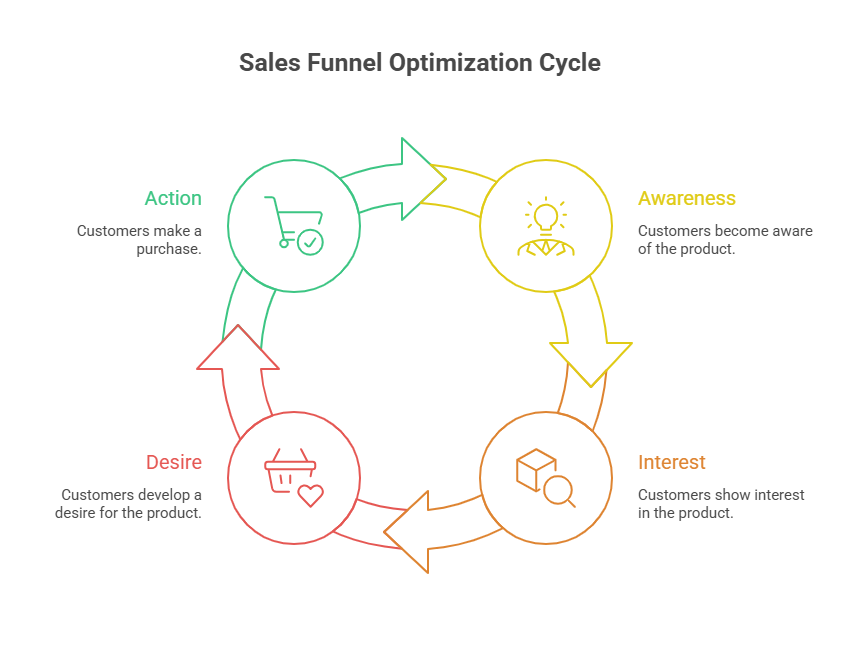
The sales funnel illustrates the process a customer goes through from becoming aware of a product to actually purchasing it. The word “funnel” is used because it shows the decreasing number of customers starting from the top who will eventually reach the bottom as buyers.
A properly constructed funnel does not direct all of the potential customers to buy at once, but rather:
- Informs the people who are not ready to buy yet
- Gradually gains their trust
- Raises the objections at the right moment
- Makes the final decision seem effortless and habitual
Marketing research shows that companies with well-articulated funnels are up to five times more successful in converting leads than those relying on disjointed campaigns.
Conversion Funnel Optimization: Where Most Funnels Lose Money
Revenue loss is inevitable even for the most effective funnels if they are not optimized.
Top Factors that Kill The Funnel
- Overly complex process
- Ineffective CTAs
- Slow page loading
- Generic communication
- No action after the sale
It is important to note that sales funnel optimization is a never-ending process and should not be seen as a one-time setup.
Measuring Funnel Performance (Simple Metrics)
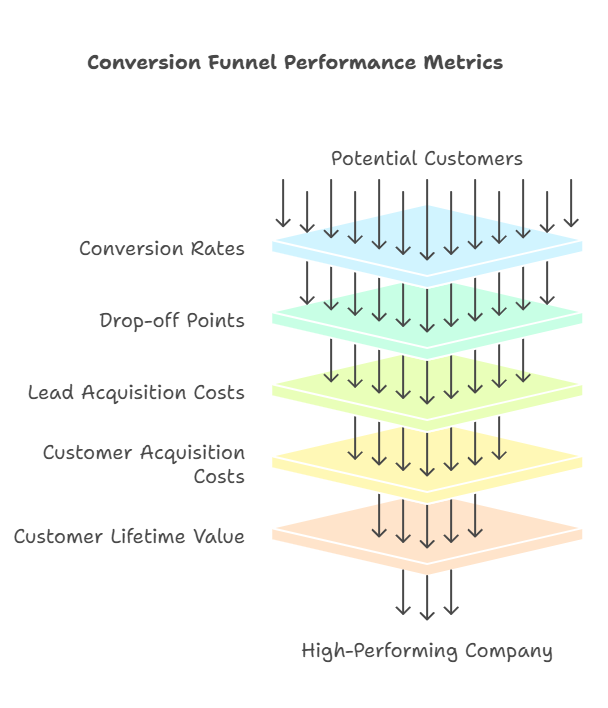
In order to know how well your funnel is working, you have to keep track of:
- Conversion rates at every level
- Where people are leaving the process
- Lead acquisition costs
- Customer acquisition costs
- Value of a customer over their lifespan
High-performing companies will review such metrics regularly and make quick adjustments.
The Core Stages of a High-Converting Sales Funnel
Most high-performing funnels follow a similar structure. The names may vary, but the intent stays the same.
Stage 1: Awareness (Top of the Funnel)
This is where everything begins. At the awareness stage, people don’t know you yet—or they barely do. They’re not ready to buy. They’re simply discovering that they have a problem or need.
Common Awareness Channels
- Blog content and SEO
- Social media posts
- Paid ads
- YouTube videos
- Podcasts and guest articles
Competitors focus heavily on educational and problem-focused content here, not sales messaging.
What Works Best at This Stage
- Clear problem statements
- Relatable pain points
- Short, helpful explanations
- Zero pressure to buy
Additional Tip:
Many funnels fail here because brands talk about themselves too early. The most effective awareness content talks about the user’s problem, not the product.
Stage 2: Interest and Engagement (Middle of the Funnel)
After gaining visibility, the next aim is to maintain their interest. The funnel can be very unfavorable for potential customers at this point if it has not been designed properly.
At this period, people inquire:
- “Is this relevant to me?”
- “Can this brand really help?”
- “Why should I trust them?”
Common Mid-Funnel Assets
- Lead magnets (guides, checklists, templates)
- Email nurturing sequences
- Webinars or workshops
- Case studies
- Educational videos
Competitor research indicates that email-based nurturing funnels have a higher conversion rate than one-time campaigns in terms of email marketing.
What This Stage Converts
- Value-first communication
- Consistent messaging across channels
- Addressing objections early
- Personalization and segmentation
Additional Tip:
High-converting funnels don’t bombard users with a plethora of options at this stage. Instead, they direct them to one specific next step.
Stage 3: Decision and Conversion (Bottom of the Funnel)
This is the critical moment. The potential customer realizes their issue, has faith in your company, and is now on the verge of making a decision.
The prospect is at this point asking:
- “Is the cost justified?”
- “Will this be suitable for my situation?”
- “What if it fails?”
Main Features of the Bottom of the Funnel
- Web pages that are designed specifically for capturing leads.
- Demo or trial product for free.
- Information regarding prices.
- Statements and comments of satisfied customers.
- Offers that are available for a short period only.
The use of social proof, i.e., testimonials, ratings, case studies, and the logos of previous clients, by competitor funnels is often very effective at this stage.
The Factors That Influence Conversions Here
- Some directional signs are easy to spot.
- Lessening the risk (free trials, guarantees)
- A very easy flow for checkout or registration.
- A very strong message of reassurance.
Additional Tip:
Removing any friction, such as extra form fields, unclear pricing, or forced account creation, can sometimes increase conversions more than adding new features.
What Top Competitors Are Doing Right
After analyzing competitor strategies across multiple sources, here are some recurring patterns used by high-converting funnels.
1. Clear Funnel Messaging at Every Stage
Competitors ensure that each stage of the funnel has a single, focused message. They don’t mix awareness content with sales pitches.
2. Heavy Use of A/B Testing
High-performing funnels constantly test:
- Headlines
- CTAs
- Button colors
- Page layouts
- Email subject lines
Sales funnel optimization through testing is one of the strongest drivers of sustained conversion growth.
3. Retargeting and Follow-Ups
Most visitors don’t convert on their first visit. Competitors use:
- Retargeting ads
- Follow-up emails
- Reminder notifications
This keeps the brand top-of-mind and recaptures lost leads.
4. Consistent User Experience
The entire journey of the customer, i.e., from advertisement to landing page and email, the same tone, visuals, and messaging are applied. This will enable trust creation and misunderstanding elimination.
Advanced Conversion Funnel Optimization Tactics That Give You a Competitive Edge
Here’s where you can outperform competitors.
Add Micro-Conversions Throughout the Funnel
Instead of pushing only for big conversions, high-performing funnels encourage small actions:
- Clicks
- Video views
- Email replies
- Content downloads
Each micro-action increases commitment and trust.
Use Behavioral Triggers, Not Just Timelines
Instead of sending emails on fixed schedules, trigger messages based on behavior:
- Page visits
- Video completion
- Abandoned forms
Behavior-based funnels convert better than time-based ones.
Optimize for Mobile First
Most funnel traffic today is mobile. We can give you the best mobile ui ux optimization services that will make your business smooth. Competitors that prioritize:
- Fast load times
- Short forms
- Thumb-friendly buttons
see higher conversion rates, especially in paid funnels.
Final Thought
A high-performing conversion or full funnel marketing strategy is all about guiding users in a clear, respectful way so they can make a decision that truly makes sense for them. When a conversion funnel is built thoughtfully, it reduces marketing waste, improves predictability, builds long-term trust, and helps businesses scale revenue more efficiently.
The best results come from applying proven marketing funnel optimization techniques, removing friction, improving clarity, and focusing on real user intent. When done well, funnel conversions increase naturally because the journey feels helpful, not forced. That’s the heart of effective funnel optimization best practices: making the process simple, valuable, and user-focused.
This is exactly where Wildnet Marketing Agency adds value. We help businesses design and refine conversion funnels that are practical, data-driven, and built around real customer behavior. From mapping the right funnel stages to improving messaging, engagement points, and conversion paths, our focus is always on outcomes: better funnel conversions, stronger trust, and sustainable growth. With the right strategy and expert execution, your funnel stops feeling like a sales process and starts working like a guided journey that naturally leads to action.
FAQs:
Q.1. What is conversion funnel optimization?
Conversion funnel optimization is a method of enhancing the entire conversion funnel in order to smoothly aid more visitors from the stage of awareness to the stage of action. It does not limit itself to final sales but rather investigates the stages where users abandon the process, what confuses them, and what takes them longer. Through the adjustments of messaging, design, and flow at each stage, companies eliminate the traffic that does not lead to any conversion and thus increase the number of visitors who become qualified leads and paying customers.
Q.2. Why is conversion funnel optimization important for businesses?
A conversion funnel optimization organizes the customer journey in a structured form. It does not push users to make an immediate purchase, but instead, it guides the users step by step, making them aware of the problem, giving them trust in the brand, and allowing them to feel secure in their decision. This method of marketing strengthens the relationships, increases the engagement, and gradually turns the conversions in the funnel into sales of higher quality.
Q.3. How is marketing conversion funnel optimization different from sales optimization?
Marketing conversion funnel optimization is directed towards the beginning and the middle stages of the customer journey, making people aware of the product, increasing their interest, and earning their trust through content, emails, and interaction. Sales optimization concerns the last steps, deal closing, and converting the already interested prospects. When both processes are running in tandem, the performance of the entire funnel improves from the very first click to the last conversion.
Q.4. What are common reasons funnel conversions drop?
Conversions through the funnel drop frequently when the overall experience is confusing or unpleasant. The most usual reasons are the slow loading of pages, vague calls-to-action, a difficult process with many steps, impersonal communication that does not relate to the user’s needs, or the absence of follow-up after the first expression of interest. The eradication of such hurdles is the foundation for the success of funnel optimization.
Q.5. What are funnel optimization best practices?
Some of the most recommended practices in funnel optimization would be to eliminate the barriers in the user journey, deliver the benefits upfront, perform trial runs of headlines and CTAs, show testimonials and other forms of social proof, and make it mobile-friendly. Constant testing and data digging are the factors through which the funnel keeps growing gradually.
Q.6. How do micro-conversions help funnel optimization?
Micro-conversions, like clicks, content downloads, video views, or email replies, are small steps that gradually develop trust and commitment. They are lessening the pressure on users and smoothing the journey over. These small steps express the intention, which in turn makes it very likely to complete larger steps later in the funnel.
Q.7. How can Wildnet Marketing Agency help with funnel optimization?
Wildnet Marketing Agency is a partner in creating and enhancing conversion funnels that are practical, data-driven, and centered around actual user behavior. The process involves mapping funnel stages, improving messaging, and so on, through which stronger funnel performance, better customer experience, and sustainable growth without wasting marketing spend are the ultimate goals.