Key Takeaways
- Understanding SEO terms helps marketers communicate strategies and improve search visibility.
- Learning core SEO vocabulary allows teams to analyze rankings, traffic, and performance effectively.
- Modern SEO terminologies now include AI-driven concepts alongside traditional search optimization.
- A strong glossary SEO knowledge helps marketers build smarter strategies and stay competitive.
Introduction
Search engine optimization continues to evolve rapidly, especially as AI-powered search, voice queries, and conversational interfaces become more common. For marketers, keeping up with these changes means understanding the language of SEO. In other words, you need to know the right SEO terms.
SEO often feels like a completely new language. Terms like “backlinks,” “crawl budget,” and “SERP features” are used frequently in digital marketing discussions. Without understanding these SEO terminologies, it can be difficult to plan effective strategies or communicate with SEO specialists.
In this guide, we’ll break down the top SEO terms every marketer should know in 2026. Think of it as a practical SEO cheat sheet that explains the most important concepts in simple language.
Why Understanding SEO Terms Matters
Before exploring the top SEO terms, it’s important to understand why learning this vocabulary matters for marketers.
Search engine optimization is not just about writing content or inserting keywords. It involves technical elements, user behavior metrics, and search engine algorithms. A solid understanding of SEO vocabulary helps marketers interpret analytics reports, plan strategies, and communicate with developers and SEO experts.
Search engines evaluate websites based on multiple factors such as content quality, backlinks, and user experience signals. These elements are discussed using specific SEO jargon, which forms the foundation of modern SEO strategies.
When marketers understand these concepts clearly, they can make smarter decisions and optimize their digital campaigns more effectively.
Essential SEO Terms Marketers Should Know
Let’s explore some of the most important SEO terms that every marketer should understand.
1. Keywords
Keywords are the words or phrases users type into search engines when looking for information. They form the backbone of SEO strategy.
For example, if someone searches for “best running shoes,” that phrase becomes a keyword marketers can target in their content.
Understanding keyword intent is essential because search engines now prioritize content that matches user intent rather than just repeating keywords.
2. SERP (Search Engine Results Page)
SERP refers to the page displayed by search engines after a user enters a query. Among the many SEO terms marketers must understand, SERP is one of the most important because it represents where optimized content appears in search results.
Modern SERPs contain more than just website links. They include features such as:
- Featured snippets
- Knowledge panels
- Image results
- AI-generated summaries
Understanding SERP features helps marketers create content that can appear in multiple search formats and improve visibility.
3. Backlinks
Backlinks are links from one website to another. They remain one of the most important ranking factors in SEO and are considered one of the essential SEO terms every marketer should know.
Search engines analyze the quality and relevance of backlinks to determine how authoritative a website is. Websites with strong backlinks tend to rank higher in search results.
This makes link-building an important part of SEO strategy.
4. Organic Traffic
Organic traffic refers to visitors who arrive at your website through unpaid search results.
Unlike paid advertising, organic traffic comes from users clicking on your website because it appears in search engine rankings, which is a core outcome of effective professional SEO services.
Marketers track organic traffic to measure the effectiveness of SEO campaigns and evaluate how well their SEO strategies are performing.
Want to Turn SEO Knowledge Into Real Business Growth?
Our SEO specialists help businesses improve rankings, increase organic traffic, and build long-term digital growth.
5. Crawl and Indexing
Search engines use bots (also called crawlers) to scan websites and understand their content.
- Crawling means discovering pages.
- Indexing means storing those pages in a search engine database.
If a page is not indexed, it will not appear in search results.
This concept is part of every glossary SEO guide because it explains how search engines discover and rank content.
6. Meta Tags
Meta tags provide information about a webpage to search engines.
Two common types include:
- Meta title – the page title shown in search results
- Meta description – a summary of the page content
Optimized meta tags improve click-through rates and help search engines understand page relevance.
7. Domain Authority
Domain Authority (DA) is a metric used to estimate how strong a website is in search rankings.
Higher authority websites generally rank better because search engines trust them more.
Factors influencing authority include:
- Quality backlinks
- Content relevance
- Website age
Although it is not an official Google ranking factor, it is widely used in SEO analysis.
8. Keyword Intent
Keyword intent describes the purpose behind a search query.
There are four main types:
- Informational intent
- Navigational intent
- Transactional intent
- Commercial intent
Understanding search intent helps marketers create content that aligns with user needs.
9. Technical SEO
Technical SEO focuses on optimizing the backend structure of a website so search engines can crawl and index it easily.
Key technical factors include:
- Page speed
- Mobile responsiveness
- Structured data
- Secure HTTPS connection
Technical SEO forms the foundation for all other SEO strategies.
10. E-E-A-T
E-E-A-T stands for:
- Experience
- Expertise
- Authoritativeness
- Trustworthiness
Search engines increasingly evaluate content based on these factors to determine credibility and ranking potential.
For marketers, this means creating trustworthy and authoritative content.
Emerging SEO Terms for the AI Era
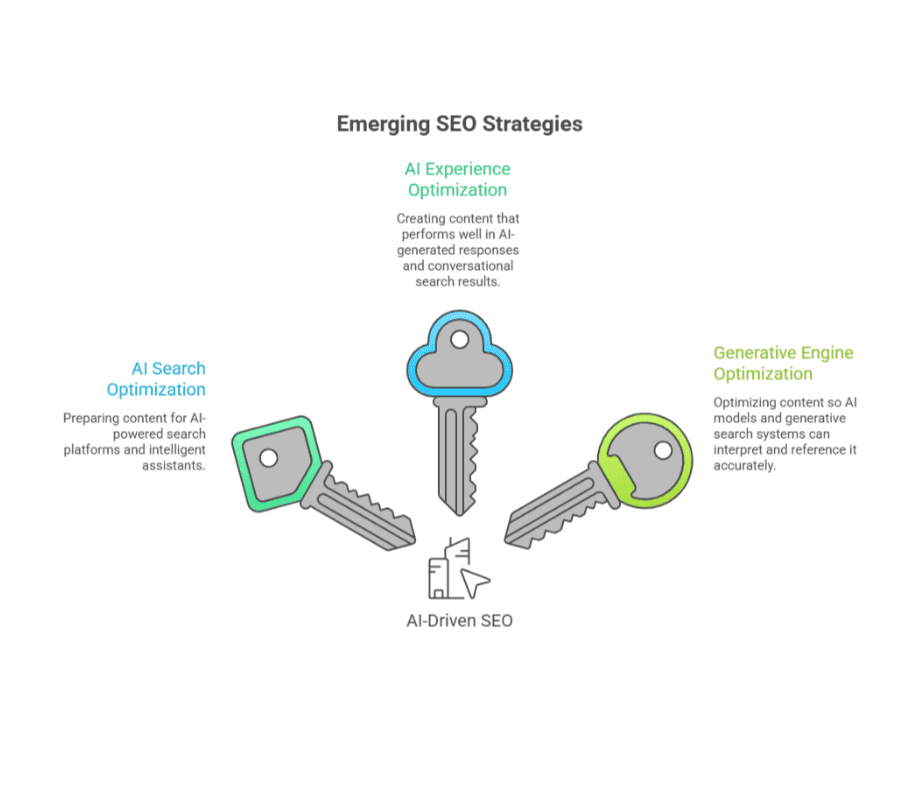
SEO services are evolving rapidly as AI-driven search engines and conversational interfaces become more common. Traditional SEO optimization services are expanding to include strategies that help content perform well in AI-generated answers and intelligent search experiences.
1. AI Search Optimization (ASO)
AI Search Optimization focuses on preparing content for AI-powered search platforms and intelligent assistants. Instead of only targeting traditional search rankings, ASO ensures that content is structured clearly so AI systems can easily interpret, summarize, and present it as part of search results.
2. AI Experience Optimization (AEO)
AI Experience Optimization is about creating content that performs well in AI-generated responses and conversational search results. As part of modern answer engine optimization services, this includes structuring information clearly, answering user questions directly, and providing reliable sources so AI systems can confidently reference the content in generated summaries.
3. Generative Engine Optimization (GEO)
Generative Engine Optimization focuses on optimizing content so AI models and generative search systems can interpret and reference it accurately. GEO strategies emphasize structured information, strong context, and authoritative content that AI engines can easily use when generating answers.
How Marketers Can Use This SEO Cheat Sheet
A practical SEO cheat sheet helps marketers apply SEO knowledge in real campaigns.
Here’s how to use these SEO key terms effectively:
- Build content strategies based on keyword intent
- Monitor organic traffic and rankings
- Improve technical SEO and page performance
- Analyze backlinks and authority signals
Conclusion
SEO continues to evolve, and staying updated with the latest SEO terminologies is essential for modern marketers. Understanding the core SEO vocabulary, from keywords and backlinks to AI-driven search optimization, helps marketers make smarter decisions and communicate strategies more effectively.
However, knowing the top SEO terms is just the first step. Implementing effective SEO strategies requires experience, technical expertise, and continuous optimization.
This is where Wildnet Marketing Agency can help. With advanced SEO strategies, technical expertise, and data-driven insights, Wildnet helps businesses improve rankings, increase organic traffic, and build sustainable digital growth in an ever-changing search landscape.
FAQs
1. What are SEO terms?
SEO terms refer to the vocabulary and concepts used in search engine optimization to describe strategies, metrics, and ranking factors.
2. Why should marketers learn SEO vocabulary?
Understanding SEO vocabulary helps marketers interpret analytics, communicate with SEO teams, and build effective search strategies.
3. What are some common SEO terminologies?
Common SEO terminologies include keywords, backlinks, SERP, crawl, indexing, domain authority, and keyword intent.
4. What is an SEO cheat sheet?
An SEO cheat sheet is a simplified guide that lists important SEO concepts and optimization techniques.
5. What are the top SEO terms beginners should know?
Beginners should learn keywords, backlinks, SERP, meta tags, technical SEO, and organic traffic.
6. How do SEO key terms help in digital marketing?
SEO key terms help marketers understand ranking factors and optimize websites to improve search visibility.
7. Are SEO terms changing in 2026?
Yes, SEO vocabulary is evolving with AI-driven search, introducing new terms like AI search optimization and generative engine optimization.