Key Takeaways
- Google Maps marketing directly impacts local SEO, often appearing before traditional organic results in high-intent searches.
- Optimized Maps listings drive real actions, calls, directions, website visits, and foot traffic.
- Reviews, updates, and engagement signal trust and relevance to both users and Google’s algorithm.
- A consistent Marketing on Google Maps strategy supports market expansion, helping businesses grow into new local areas with confidence.
Introduction
Every day, millions of people use their phones to look for nearby businesses from “best coffee near me” to “plumber open now.” In fact, local searches (like “near me” queries) have grown by over 900% in just a few years, and nearly 97% of online users search for local businesses before making a decision.
This shift in search behaviour makes Google Maps marketing a powerful catalyst for businesses that want to expand reach, increase foot traffic, and boost online visibility. Whether you’re a storefront or a service provider, mastering map marketing helps you get found and chosen over competitors, especially when people are ready to act.
In this blog, we’ll explain why Marketing on Google Maps matters, how it directly influences SEO, and practical steps you can take to use Google Maps for your business to grow reach and market share.
What Is Google Maps Marketing?
Google Maps marketing refers to the practice of optimizing your business’s presence on Google Maps so that your location and services show up prominently when people search nearby or for relevant services.
It’s not just about being visible on a map; it’s about making sure your business appears at the top of local searches, in the “Map Pack”, and ranks higher in both Google Maps and local organic listings.
This visibility helps you get more calls, website visits, clicks for directions, and ultimately more customers through the door.
Why Google Maps Marketing is Important for SEO and Growth
Google Maps marketing enables businesses to achieve measurable results because it directly affects their local business rankings and their ability to attract customers and achieve business expansion. Google displays the Map Pack before showing organic search results when users search for services with the phrase “near me” or search for businesses in particular locations. Marketing on Google Maps provides businesses with an advantage because their optimized presence displays before regular SEO results.
Google Maps transmits strong local signals to Google, which helps with SEO evaluation. An optimized profile increases local search relevance, geographic distance, and important business presence, which are essential ranking criteria. Businesses that maintain their Maps profile through correct information, customer reviews, photos, and new content tend to achieve better rankings on Maps and in local organic search results, making local SEO marketing services more effective.
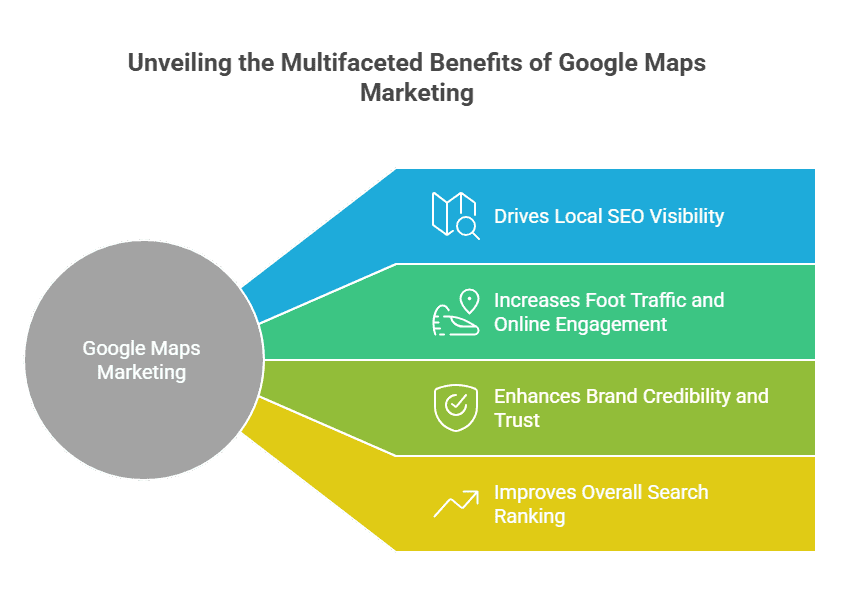
1. Drives Local SEO Visibility
Appearing on Google Maps significantly boosts your local SEO. When someone searches for products or services in your neighbourhood, Google often shows the Map Pack and the carousel of top-ranked local businesses even before traditional organic search results.
Getting into that Map Pack dramatically increases your chances of being found before your competitors. Research shows that businesses in the top spots of local listings receive a much higher share of clicks compared with those buried farther down or not listed at all.
2. Increases Foot Traffic and Online Engagement
Google Maps marketing makes it easy for customers to find your location, phone number, website, or directions with a single tap, especially on mobile devices.
Because people using Maps are often ready to act, businesses that show up here are far more likely to get calls, visits, and leads than those that rely solely on organic search.
3. Enhances Brand Credibility and Trust
Listings on Google Maps include reviews, ratings, photos, and business details. These elements act like social proof: they immediately increase a business’s trustworthiness in the eyes of potential customers.
Consumers today rarely make decisions without looking at reviews, and a strong presence on Maps signals reliability and quality.
4. Improves Overall Search Ranking
Google considers many signals when ranking local businesses: relevance, proximity to the searcher, and prominence (how well-known or reviewed you are).
How Google Ranks Businesses in Maps
Google doesn’t randomly list businesses; it uses algorithms similar to regular SEO but tailored for local relevance. The main factors include:
- Proximity: How physically close your business is to the searcher’s location
- Relevance: How well your listing matches what the user is searching for
- Prominence: How established and active your Business Profile is, including reviews and engagement.
This is why a strong Marketing on Google Maps strategy is helpful it helps Google understand your business better and trust your relevance.
Optimizing Your Google Maps Marketing Strategy for SEO
A strong Marketing on Google Maps strategy doesn’t just help people find your business; it directly strengthens local SEO signals and opens the door to new market opportunities. Below are 10 proven, practical strategies that show exactly how Marketing on Google Maps drives SEO and market expansion.
1. Claim and Fully Complete Your Google Business Profile
Your Google Business Profile is the foundation of maps marketing. A complete profile helps Google clearly understand who you are, what you offer, and where you operate.
Make sure you:
- Add accurate name, address, and phone number (NAP)
- Select the most relevant primary and secondary categories
- Write a clear, keyword-aware business description
- Link to your website and booking pages
A fully optimized profile improves your chances of appearing in the Local Pack and Maps results, making GMB optimization service an essential strategy.
2. Maintain Consistent and Updated Business Information
Google prioritizes reliability. Even small inconsistencies like different phone numbers across platforms can hurt rankings.
Why this matters for SEO and growth:
- Improves Google’s trust in your listing
- Reduces user confusion
- Strengthens local authority signals
Regular updates tell Google your business is active and operational.
3. Encourage and Actively Manage Customer Reviews
Reviews influence rankings, clicks, and conversions.
To optimize:
- Ask satisfied customers for reviews at the right moment
- Respond to every review (positive or negative)
- Address concerns professionally and promptly
Active review management improves engagement metrics and signals relevance, both critical for Google Maps visibility and market expansion.
4. Add High-Quality Photos and Videos Frequently
Businesses with fresh visuals consistently outperform static listings.
Why visuals matter:
- Increase profile engagement
- Improve click-through rates
- Build trust before customers visit
Photos also help users decide faster, which increases calls, direction requests, and foot traffic.
5. Use Google Posts to Signal Activity
Google Posts let you share updates, offers, events, and announcements directly on your Maps listing.
SEO impact:
- Signals freshness and relevance
- Keeps users engaged on your profile
- Supports promotions during seasonal or regional expansion
This is an underused but powerful Google Maps marketing strategy.
6. Optimize with Local Keywords (Naturally)
Using local search terms helps Google connect your business with relevant queries.
Best practice:
- Include service + location in your description
- Add keywords to posts, services, and FAQs
- Avoid keyword stuffing
This directly supports how to use Google Maps for business discovery in competitive markets.
7. Build Strong Local Citations
Citations are mentions of your business on directories, review sites, and local platforms.
Why they matter:
- Reinforce NAP consistency
- Increase local prominence
- Support ranking stability across regions
Strong citation coverage helps businesses expand into nearby markets with confidence.
8. Add and Optimize Products & Services
Google allows you to list services and products inside your profile.
Benefits:
- Improves keyword relevance
- Helps users understand offerings quickly
- Supports conversion-focused searches
This is especially powerful for service-based businesses and multi-location brands.
9. Track Insights and User Behavior
Google Business Profile Insights show:
- How users find you
- Where do they come from
- What actions do they take
Use this data to:
- Identify high-performing locations
- Adjust your Google Maps marketing strategy
- Discover expansion opportunities based on demand patterns
Data-driven optimization fuels smarter market growth.
10. Monitor and Outperform Competitors
Your Maps ranking is relative.
Regularly analyze:
- Competitor review count and quality
- Posting frequency
- Category and keyword usage
Matching and exceeding competitor activity is essential for staying visible as markets grow.
Google Maps Marketing vs Traditional SEO
While traditional SEO focuses on ranking webpages in organic search results, Marketing on Google Maps focuses on rankings in local map searches and the Map Pack.
Both are important, but Maps marketing is especially powerful for local businesses with physical locations or service areas because it connects with users at the moment of intent (when they are searching “near me” or seeking immediate services). This makes it a critical part of any comprehensive local SEO and growth strategy.
Boost Your Local Visibility with Google Maps Marketing
Get found by more customers, increase foot traffic, and grow your business with a fully optimized Google Maps presence. Start turning searches into real-world results today.
Benefits of Google Maps Marketing for Businesses
When done right, Marketing on Google Maps becomes more than a visibility tool—it directly supports SEO performance and business growth. Each benefit ties back to how customers discover, evaluate, and choose local businesses.
Higher visibility in local searches
Google often prioritizes Maps results above standard organic listings, especially for location-based queries. A strong Marketing on Google Maps strategy helps your business appear in the Local Pack, giving you prime placement when users search with local intent. This expands reach in targeted geographic markets where buying intent is already high.
More clicks, calls, and direct actions
Maps listings are action-driven by design. With one-tap options for calling, directions, and website visits, maps marketing reduces friction in the customer journey. This leads to higher engagement rates than traditional search results and directly contributes to lead generation and conversions.
Increased foot traffic from nearby users
Mobile users rely heavily on Maps for “near me” searches. Optimizing how to use Google Maps for business ensures your listing surfaces at the exact moment users are ready to visit. This is especially powerful for retail, restaurants, healthcare, and service-based businesses looking to grow locally.
Improved credibility through reviews and ratings
Reviews are a trust signal for both users and Google. Consistent positive ratings improve click-through rates and influence local rankings. Strong review activity reinforces your authority in a specific area, supporting both SEO and long-term market expansion.
Stronger support for overall SEO performance
An optimized Maps presence reinforces local SEO signals like relevance and proximity. Businesses with active Google Maps profiles often see better performance across local organic search, making Marketing on Google Maps a key driver of sustainable growth, not just short-term visibility.
Common Mistakes to Avoid in Google Maps Marketing
The Marketing on Google Maps strategy will not deliver successful results when common errors in execution remain unaddressed. Your Maps presence will benefit SEO and business growth when you avoid these mistakes.
Incomplete or inconsistent business information
Both users and Google’s local algorithm need consistent NAP details, which show name, address, and phone number, and yet business categories are wrong, and operating hours are missing. Your listing will not rank in competitive local searches because trust signals will be diminished. The core requirements for successful map marketing depend on accuracy and consistency.
Ignoring customer reviews
Reviews exist as active content because they need active involvement from people. The lack of response to reviews, especially negative reviews, demonstrates low engagement, which results in diminished credibility. Active listings receive preference from Google because users depend on review responses to make their location decisions. Review management exists as a mandatory requirement because it serves both ranking purposes and conversion goals.
Not updating images or Google Posts
Outdated photos or inactive profiles reduce user interaction. Fresh images and regular updates signal relevance and business activity, which directly impacts visibility. Businesses that treat Maps profiles as “set and forget” often lose ground to more active competitors.
Failing to track and analyze competitors
The competitors who post content more frequently and obtain additional customer feedback, together with their superior keyword selection, will achieve better search rankings than you. The analysis of competitor listings enables businesses to enhance their Google Maps performance while adjusting their market position and sustaining their presence throughout local market fluctuations.
Conclusion
Marketing on Google Maps is no longer just a local listing tactic; it’s a powerful SEO and market expansion channel. When optimized correctly, it places your business in front of users at the exact moment they’re ready to take action. From improving local rankings and visibility to driving calls, visits, and trust through reviews, Marketing on Google Maps connects discovery with real-world results.
The businesses that win locally are not just “listed” on Maps, they actively manage their presence. They keep information accurate, publish updates, respond to reviews, analyze insights, and outperform competitors consistently. This is how Marketing on Google Maps strengthens SEO signals and supports sustainable growth across neighborhoods, cities, and even regions.
For brands looking to scale faster, agencies like Wildnet Marketing Agency help design and execute data-driven Marketing on Google Maps strategies that align with SEO goals and long-term market expansion. From profile optimization to citation building and competitive tracking, Wildnet helps businesses turn Maps visibility into measurable growth.
FAQs
1. What is Marketing on Google Maps?
Marketing on Google Maps is the process of optimizing your Google Business Profile to improve visibility, rankings, and engagement in local map searches.
2. How does Marketing on Google Maps help SEO?
It strengthens local SEO signals like relevance, proximity, and prominence, helping businesses rank higher in both Maps and local organic results.
3. Is Marketing on Google Maps only for local businesses?
It’s most effective for local and service-area businesses, but multi-location and expanding brands also benefit significantly.
4. How long does it take to see results from Maps marketing?
Improvements can appear within weeks, but consistent optimization delivers stronger results over time.
5. Do reviews really affect Google Maps rankings?
Yes. Review quantity, quality, and response activity directly influence trust, visibility, and user engagement.
6. What’s the difference between Marketing on Google Maps and traditional SEO?
Traditional SEO focuses on webpages, while Maps marketing targets local intent searches and the Map Pack for faster conversions.
7. Can an agency help manage Marketing on Google Maps?
Yes. Agencies like Wildnet Marketing Agency manage optimization, reviews, citations, and competitive analysis to drive consistent growth.