Key Takeaways
- Cross linking in SEO helps spread ranking power across pages and improves site navigation.
- The ChatGPT Strategic internal linking boosts topical authority and helps search engines understand content relationships.
- Avoid overdoing SEO by using multiple links to the same page on one page to prevent dilution or confusion.
- Reciprocal links in SEO are different; it involves trading links with other sites and should be used with caution.
Introduction
Every year, the way people search and discover content changes, but one thing remains constant: the importance of how pages are linked online. In fact, Backlinko conducted research that found that websites with strong internal linking systems achieve better Google rankings and receive increased organic traffic. Google and other search engines use page links, which include both internal links and external links, as essential indicators to determine website content relevance and site authority.
Yet despite this, many businesses still overlook a fundamental SEO tactic: Cross linking in SEO. Too often, site owners focus only on external links (or backlinks), ignoring how internal connections between pages and the smart use of links from other sites can exponentially increase visibility. In this blog, we’ll break down what cross-linking in SEO really is, why it matters for rankings, how search engines use it, and how you can apply it strategically without overdoing it
What Is Cross Linking in SEO?
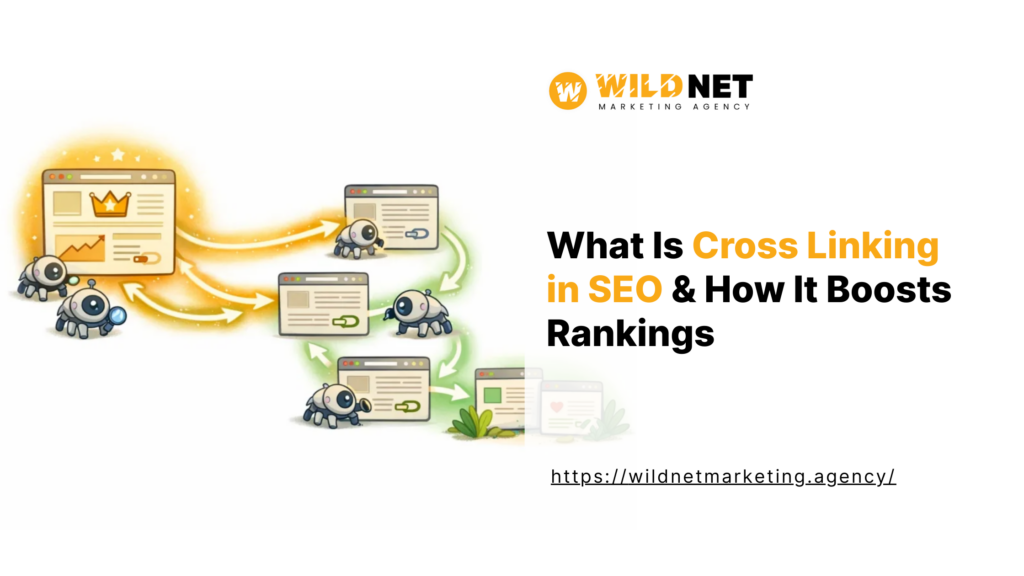
Cross linking in SEO refers to the practice of linking from one page of your website to another page within the same domain. This method of internal linking enables your website to share its ranking power with all its pages while assisting search engines in determining how different content parts connect with each other.
In simpler terms, when you create content for your blog, product page, or resource page, you need to create links that direct users to other relevant content on your website. These links are called cross-links.
For example:
- A blog post about “10 Healthy Breakfast Recipes” could link to another article on “Meal Planning Tips.”
- A product page for running shoes might link to a “How to Choose Running Shoes” guide
- When cross-linking occurs through intentional planning, it enables both users and search engines to discover important content while boosting your website’s SEO results.
Why Cross Linking in SEO is Important for Rankings
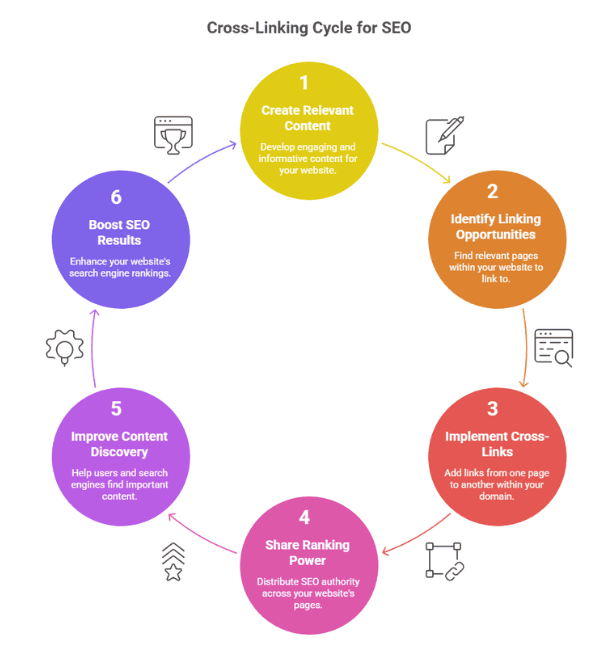
Cross linking in SEO establishes essential pathways that enable both users and search engines to navigate through your website. The system creates structured connections between your pages, which enables search engines to identify your most important content while understanding the relationships between different subjects. Here’s how Cross linking in SEO makes a real difference in practice:
1. Improves Crawlability & Indexing
Search engine bots crawl by following links. The more structured your internal link network, the easier it is for bots to find, crawl, and index pages.
Think of your website as a city:
- Pages are like buildings
- Links are the roads connecting them
If there are dead ends or isolated pages, search bots & users get “lost.” Cross-links act like signs that guide search crawlers and visitors smoothly through your content.
2. Boosts Page Authority Distribution
Every page on your site has some measure of authority, whether from external links, user engagement, or internal signals. When one of your top pages gets linked from another trusted page, it can pass some of that authority on.
This chain of influence is especially powerful when you have multiple cross-links pointing to a key page.
For example:
- Your homepage might be the most authoritative page
- Linking from other high-traffic pages to a promotional landing page helps distribute some of that strength, improving visibility and ranking potential for that strategic page
This idea is closely related to linking SEO, and cross-linking helps “spread” authority across relevant content.
3. Improves Relevance & Topical Signals
Search engines don’t just look at links, they analyze context.
When multiple related pages link to each other (e.g., “SEO Basics”, “Internal Linking Strategy”, and “Cross Linking in SEO”), it tells algorithms that your site has deep coverage around a topic. This clustered structure improves relevance signals and boosts your chances of ranking for related keywords. That’s why businesses often invest in a professional internal linking optimization service to strategically connect content, strengthen topical authority, and ensure search engines clearly understand the relationships between pages. It’s similar to how academic citations work: a research paper that is cited by other papers in the same field gains authority within that subject area.
4. Enhances User Experience & Engagement
Cross-links make it easier for visitors to find related content that matches their interest or intent.
For example:
A user reading a “Beginner’s Guide to SEO” might naturally want to explore “How to Build Internal Links” or “SEO Tools for Beginners.” Cross-links help guide that journey without confusion.
Good linking leads to:
- Lower bounce rates
- Higher session duration
- Better conversion paths
All of these behaviors are good signals to search engines.
Cross Linking vs Reciprocal Linking in SEO
While both involve links, they work very differently and carry very different levels of control and risk. Knowing when to use each (and when to avoid them) helps you build authority without triggering search engine penalties.
Key Differences at a Glance
| Aspect | Cross Linking (Internal) | Reciprocal Link in SEO (External) |
| Where the link exists | Within the same website | Between two different websites |
| Level of control | Fully controlled by you | Partially or not controlled |
| SEO safety | Safe and recommended | Risky if overused or low-quality |
| Primary purpose | Site structure & relevance | Authority exchange |
| Search engine trust | High | Moderate to low if abused |
| Best use case | Internal content connection | Genuine partnerships only |
Does Cross-Linking Impact Ranking Directly?
Yes, but not in the simplistic way many beginner SEO guides imply.
Here’s how cross-linking influences SEO:
- Improves Crawl Efficiency
Search bots follow links to discover pages. Better cross-linking means deeper pages get indexed more reliably.
- Spreads Link Equity
Internal links help share authority across priority pages.
- Clarifies Content Relationships
Search engines can better group and understand topical relevance.
- Enhances User Experience
User behavioral signals inform search algorithms.
What cross-linking doesn’t do:
- It won’t magically rank a low-quality page above high-quality competitors simply because of internal links
- Excessive links with no context add no real SEO value
In short, cross-linking amplifies the strength of well-organized, high-value content; it doesn’t mask weak content.
SEO Multiple Links to Same Page — Does It Help?
When building internal links, a common question is whether adding multiple SEO links to the same page from a single page matters.
For example:
If Page A has two or three links pointing at Page B, should this improve the ranking for Page B within the search results?
The short answer:
It is as much as the contextualized and lexicalized information and beneficial links allow.
When It Helps
- Both links are placed logically within relevant content
- Anchor text differs contextually (not spammy)
- Links are part of user navigation, not forced
Example:
You have an FAQ page about SEO optimization:
- In one sentence, you link to “Cross linking in SEO strategies.”
- Later in the same article, you link again to a section about “advanced internal linking best practices.”
If both links genuinely serve the reader, this can reinforce relevance.
When It Doesn’t Help
- Multiple repetitive links with identical anchor text
- Links inserted only for SEO without user value
- Link stuffing
Search engines may discount or ignore redundant links. The best practice is to use cross-links where they help users read naturally, not to artificially inflate link counts.
Real-Life Example of Cross Linking in Action
Let’s say you run a health and wellness blog.
You have multiple articles:
- “Benefits of Morning Workouts”
- “10 Best Exercises for Beginners”
- “Healthy Snack Ideas for Active Lifestyles”
By using Cross linking in SEO, you can link between these related posts:
In “Benefits of Morning Workouts”
- Link to “10 Best Exercises for Beginners”
- Link to “Healthy Snack Ideas for Active Lifestyles”
This accomplishes three things:
- Keeps readers engaged longer
- Helps bots discover connected content
- Sends clear topical signals between pages
Now, if you add a pillar resource called “Complete Guide to Fitness & Nutrition.” You can link to this central hub from all three related articles, increasing its authority and helping it rank higher for broader terms like “fitness guide.” This is the essence of smart, strategic cross-linking in SEO .
Best Practices for Cross Linking in SEO
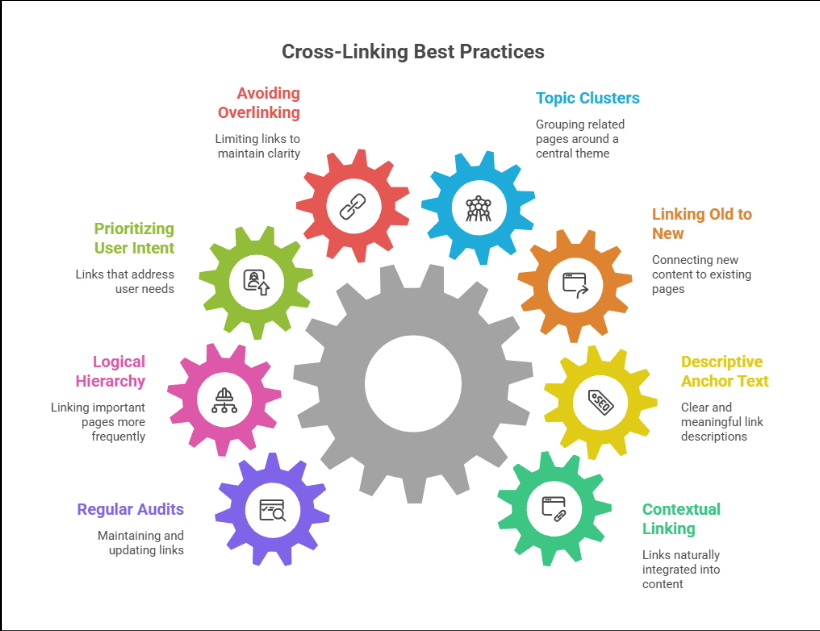
When done correctly, Cross linking in SEO strengthens your site structure, improves rankings, and makes content easier for users to navigate. But poor linking can confuse both readers and search engines. The eight best practices below show you effective ways to implement them because we provide simple explanations.
1. Link Contextually, Not Randomly
The most valuable cross links appear naturally inside your content, not forced into sidebars or footers. Contextual links help search engines understand why two pages are related.
When a link supports the topic being discussed, it improves relevance and encourages users to explore further, boosting engagement and time on site.
2. Use Descriptive Anchor Text
Anchor text tells search engines what the linked page is about. Generic phrases like “click here” or “read more” waste SEO potential.
Instead, use meaningful phrases that describe the destination page clearly. This improves clarity for readers and strengthens keyword relevance for search engines.
3. Link Old Content to New Content
Every new article you publish is an opportunity to strengthen existing pages. Go back to older, relevant posts and add cross links to your new content.
This practice helps:
- Faster indexing of new pages
- Distribution of existing authority
- Improved freshness signals
It’s one of the easiest ways to improve SEO without creating new content.
4. Create Topic Clusters
Topic clusters are groups of related pages linked around a central “pillar” page. This structure helps search engines understand topical depth and expertise.
For example:
- Main guide → supporting blogs → related subtopics
Cross linking within clusters builds authority and helps pages rank collectively rather than individually.
5. Avoid Overlinking
More links don’t always mean better SEO. Too many links on one page can overwhelm users and dilute link value.
A good rule:
Only link when it adds clear value to the reader. Quality always beats quantity when it comes to internal cross links.
6. Prioritize User Intent
Every cross link should answer a logical next question in the reader’s mind. Ask yourself:
- Does this link help the user understand the topic better?
- Does it solve a follow-up problem?
When links follow user intent, engagement improves naturally, and so do rankings.
7. Use a Logical Linking Hierarchy
Your most important pages should receive the most internal links. This tells search engines which pages matter most.
Best practice:
- Homepage → category pages → detailed articles
- Avoid orphan pages with no internal links
This hierarchy strengthens crawlability and authority flow.
8. Regularly Audit and Update Links
As content grows, some links become outdated or irrelevant. We provide a comprehensive SEO audit service that reviews your internal linking framework, identifies gaps, and ensures your website stays optimized for better rankings and performance. Regular internal link audits help you:
- Fix broken links
- Update anchors
- Improve relevance
- Remove unnecessary links
Search engines reward well-maintained websites that evolve over time.
Common Mistakes to Avoid in Cross linking in SEO
Even though Cross linking in SEO is a powerful strategy, small mistakes can reduce its effectiveness or even hurt user experience. Many of these errors happen unintentionally, especially as a website grows. Understanding what not to do is just as important as following best practices.
1. Linking Unrelated Pages
One of the most common mistakes is linking pages that don’t have a clear topical connection. Search engines look at links as signals of relevance. When you connect unrelated content, it weakens that signal and confuses both users and crawlers.
If a link doesn’t logically help the reader understand the topic better, it probably doesn’t belong there.
2. Stuffing Keywords Into Anchor Text
Over-optimizing anchor text by forcing exact-match keywords into every link can do more harm than good. It makes content feel unnatural and may raise red flags for search engines. Anchor text should sound natural, readable, and helpful, written for humans first, SEO second.
3. Adding Cross Links Only for SEO, Not Users
Cross-links created purely to manipulate rankings usually fail. If a link doesn’t provide value, readers won’t click it, and search engines will notice low engagement. Effective linking SEO always starts with user intent. If it improves navigation or understanding, SEO benefits follow naturally.
4. Ignoring Deep Pages
Many websites only link to top-level pages like homepages or category pages, leaving deeper content buried and underperforming. Deep pages, such as detailed guides or niche blogs, often hold high value. Without cross-links pointing to them, they remain invisible to search engines and users alike.
5. Forgetting to Update Links as Content Grows
As your site expands, older links can become outdated or less relevant. Broken links, outdated references, or missed opportunities weaken internal structure. Regularly revisiting and refreshing cross-links ensures your site stays organized, relevant, and SEO-friendly.
Ready to Strengthen Your SEO With Smart Internal Linking?
Cross linking in SEO isn’t just about connecting pages — it’s about building authority, improving crawlability, and boosting rankings. Let our experts create a structured internal linking strategy that drives measurable growth.
How Cross Linking in SEO Fits Modern Search
Search engines today are far more advanced than they were a few years ago. They no longer evaluate pages in isolation or rely only on keywords. Instead, modern search engines focus heavily on context, user intent, and the relationships between pieces of content. This shift is exactly why cross linking in SEO has become more important than ever.
At a high level, cross-linking helps search engines see your website as a connected knowledge system rather than a collection of disconnected pages. When your content is thoughtfully linked, it tells search engines how topics relate, which pages support others, and where deeper explanations live.
Cross linking in SEO helps modern search engines:
- Understand topic coverage by seeing how multiple pages collectively answer a subject
- Identify pillar content that acts as the main authority hub
- Evaluate relevance signals across related pages instead of ranking content in isolation
This structure aligns perfectly with how AI-driven search works today. AI models look for meaning, depth, and relationships, not just exact keywords. Websites that build strong internal content ecosystems through smart cross-linking are easier for search engines to understand, trust, and rank.
Conclusion
SEO cross-linking establishes content organization and expert knowledge for search engines and users on your blog, eCommerce site, or service-oriented website. The Wildnet Marketing Agency helps brands develop internal linking structures that drive SEO results for sustained growth and ranking improvements because their SEO strategies require expansion. Today, cross-linking functions as an essential requirement that establishes the foundation for sustainable search engine optimization systems.
FAQ
1. What is Cross linking in SEO?
Cross-linking in SEO involves creating links between different pages of your website that relate to each other through your domain to enhance user navigation, website crawlability, and search engine ranking performance.
2. How does cross-linking in SEO improve rankings?
The process enables search engines to determine how different pieces of content connect with each other while distributing link equity throughout the website and boosting user engagement indicators, such as duration spent on the website
3. Is cross-linking the same as a reciprocal link in SEO?
Cross-linking enables you to create links between different pages on your website, whereas reciprocal linking requires two separate websites to create mutual links between them.
4. Can SEO multiple links to the same page help?
Yes, but only when links are contextually useful. Repeated or forced links with the same anchor text may be ignored by search engines.
5. How many internal cross-links should a page have?
There’s no fixed number. Add links naturally where they help users. Quality and relevance matter more than quantity.
6. Does cross-linking help new pages rank faster?
Yes. Linking new pages from existing authoritative content helps search engines discover and index them more quickly.
7. How often should I update cross-links?
Regularly. As you publish new content or update old pages, refresh your internal links to keep your SEO structure strong and relevant.